
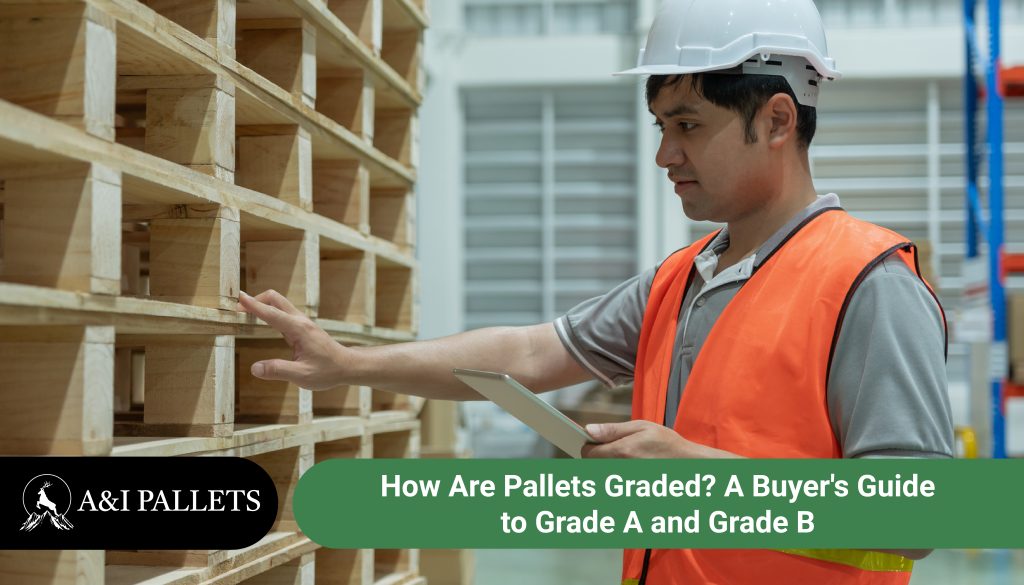
Pallet grading helps buyers understand the general condition and repair history of used pallets. Grade A, commonly referred to as #1, generally represents a cleaner used pallet with fewer or no significant stringer repairs, while Grade B, often called #2, may have approved repairs but remain suitable for many shipping and warehouse applications.
Businesses purchasing #1 & #2 pallets should not assume that grade describes dimensions, species, or a universal weight capacity. It primarily helps distinguish condition and repair characteristics within used pallet inventory.
Companies comparing #1 & #2 pallets for sale should also confirm exactly how the supplier defines each grade. Terminology can vary, making specifications and intended use more important than relying on the grade name alone.
What “Grade” Actually Refers to (Hint: Not Size)
Grade describes a pallet’s condition and repair history rather than its dimensions.
Two used pallets can both measure 48×40 inches while receiving different grades because one remains closer to its original construction and another has undergone repairs.
Grading helps businesses sort used inventory according to general condition so buyers can select pallets appropriate for their application and budget.
The exact criteria can vary between pallet suppliers and recycling operations. Buyers placing larger or recurring orders should therefore discuss what the supplier means by Grade A, Grade B, #1, or #2 before purchasing.
Grade A (#1): All-Original Stringers, No Repairs
Grade A or #1 pallets are generally the higher grade of commonly used pallet inventory.
They typically have a cleaner overall appearance and fewer repairs. Depending on the supplier’s grading system, #1 pallets may have original stringers without companion stringer repairs and may be selected for their stronger appearance and overall condition.
Premium #1 & #2 pallets can be useful when businesses want carefully selected inventory that meets defined condition requirements.
Grade A may be particularly appealing when pallets will remain visible to customers, move through retail distribution, or represent the shipper in a customer-facing environment.
However, buyers should still confirm individual specifications rather than assuming the #1 designation establishes every performance characteristic.
Grade B (#2): Structurally Sound but Repaired
Grade B or #2 pallets are used pallets that may show more wear and typically allow certain repairs.
For example, a damaged stringer may have been reinforced with a companion board or other accepted repair method. Deck boards may also have been replaced as part of the pallet’s service history.
That does not automatically make a #2 pallet unsuitable.
For many warehouse, manufacturing, internal freight, distribution, and one-way shipping applications, properly inspected used #1 & #2 pallets can provide a practical alternative to higher-grade inventory.
The important question is whether the pallet’s condition and specifications are appropriate for the load and handling environment.
How Graders Visually and Structurally Inspect Each Pallet
Used pallets should be evaluated for more than appearance.
Inspection can identify damage or wear that may affect continued use. The exact process varies by supplier and pallet type, but common areas of attention can involve:
- Broken Deck Boards
- Cracked Stringers
- Missing Components
- Previous Repairs
- Protruding Fasteners
- Excessive Wear
- Contamination
- Overall Structural Condition
A pallet may look worn while remaining useful for an appropriate application. Another may appear relatively clean but have structural damage that requires repair or removal from service.
Custom #1 & #2 pallets and sorted pallet programs can also be developed around customer specifications when an operation has particular dimensional, condition, or handling requirements.
Load Capacity: Does Grade Affect How Much Weight It Holds?
Grade alone should not be used as a load-capacity rating.
A pallet’s ability to support a load depends on its design, dimensions, lumber, construction, fasteners, condition, repairs, load distribution, handling method, and support conditions.
A higher cosmetic or condition grade does not automatically provide a specific weight rating.
Businesses should evaluate pallets according to the loads they actually intend to move. Heavy, concentrated, unusually shaped, or valuable products may require additional consideration beyond whether a pallet is categorized as #1 or #2.
Companies preparing to Buy #1 & #2 Pallets should provide the supplier with information about the intended load and handling environment when those factors are important to pallet selection.
Matching Grade to Use Case: Customer-Facing vs. Internal Freight
The highest available grade is not necessary for every shipment.
A business shipping finished products to retailers or customers may prefer cleaner, more uniform pallets because appearance matters alongside function.
Internal transfers can have different priorities.
Manufacturing plants, warehouses, and distribution operations moving materials between facilities may find Grade B inventory appropriate when the pallets meet their structural and operational requirements.
Used #1 & #2 pallets can therefore support different applications within the same organization.
A company might use higher-grade pallets for outbound customer shipments while using properly inspected Grade B pallets for internal product movement, storage, or other suitable applications.
Price Differences between Grade A and Grade B
Grade A pallets generally command a higher price because the available inventory must meet a higher condition standard.
Grade B pallets may cost less because repaired units and pallets showing additional wear can qualify for that category.
Actual pricing can also be affected by:
- Pallet Size
- Quantity
- Current Inventory
- Lumber Market Conditions
- Required Specifications
- Sorting Requirements
- Delivery Location
- Recurring Volume
For larger operations, the best value is not necessarily the least expensive pallet. Selecting a grade appropriate for the application can help businesses avoid paying for a higher condition level where it provides little operational benefit.
Why Grading Standards Can Vary between Suppliers
Pallet grades are commonly used throughout the industry, but buyers should not assume every supplier applies identical sorting criteria.
One supplier’s #1 inventory may not match another supplier’s exactly.
That makes communication especially important for businesses purchasing #1 & #2 pallets in substantial quantities or establishing a recurring supply program.
Instead of specifying only “Grade A” or “Grade B,” buyers can discuss dimensions, repair allowances, appearance, condition, application, quantity, and other relevant requirements.
Clear specifications make it easier to maintain consistency across future orders.
Planning Larger and Recurring Grade-Specific Orders
Businesses using significant pallet volumes may need more than a one-time purchase.
Manufacturers, warehouses, distribution centers, contractors, government programs, and commercial operations can require a steady flow of pallets that meet consistent specifications.
A&I Pallets can coordinate pallet sourcing, custom manufacturing, repairs, transportation, collection, recycling, and recurring supply based on operational requirements.
Companies searching for #1 & #2 pallets for sale can discuss expected volume, grade, size, intended application, delivery schedule, and other specifications before ordering.
This can be particularly useful when pallet demand changes with production levels, shipping schedules, or seasonal activity.
Frequently Asked Questions
Are Grade A and #1 pallets the same thing?
The terms are commonly used interchangeably for higher-grade used pallet inventory, although exact grading criteria can vary by supplier. Buyers should confirm the specifications associated with the grade before ordering.
Are Grade B pallets safe to use?
Grade B pallets may be suitable for many applications when they have been properly inspected and repaired. Suitability depends on the pallet’s condition, construction, load, handling method, and intended use rather than the grade name alone.
Can I order used #1 & #2 pallets in large quantities?
Yes. Availability depends on the required dimensions, grade, specifications, quantity, and current inventory. Businesses with larger or recurring requirements should discuss expected volume and delivery needs with the supplier.
Is a #1 pallet always stronger than a #2 pallet?
Not necessarily. Grade primarily describes condition and repair history. Load performance depends on pallet construction, materials, condition, support, load distribution, and other factors.
Should I buy Grade A or Grade B pallets?
The appropriate choice depends on how the pallets will be used. Customer-facing shipments may benefit from cleaner higher-grade inventory, while properly inspected Grade B pallets may be suitable for internal freight and other applications where appearance is less important.
Summary
Pallet grading gives buyers a practical way to distinguish used inventory by condition and repair history, but the grade should never be the only purchasing consideration. #1 & #2 pallets can serve different roles depending on appearance requirements, load characteristics, handling conditions, and budget. When comparing #1 & #2 pallets for sale, buyers should confirm the supplier’s grading criteria and match the pallet specifications to the actual application rather than choosing by grade name alone.
Find the Right Pallet Grade for Your Operation
A&I Pallets supplies new and used wood and plastic pallets for manufacturers, warehouses, distribution centers, government programs, contractors, and commercial operations. Whether you need Grade A, Grade B, recurring pallet deliveries, custom specifications, or higher-volume orders, our team can help match pallet condition and construction to your operational requirements. Call today to discuss your pallet needs – (323) 567-8574.